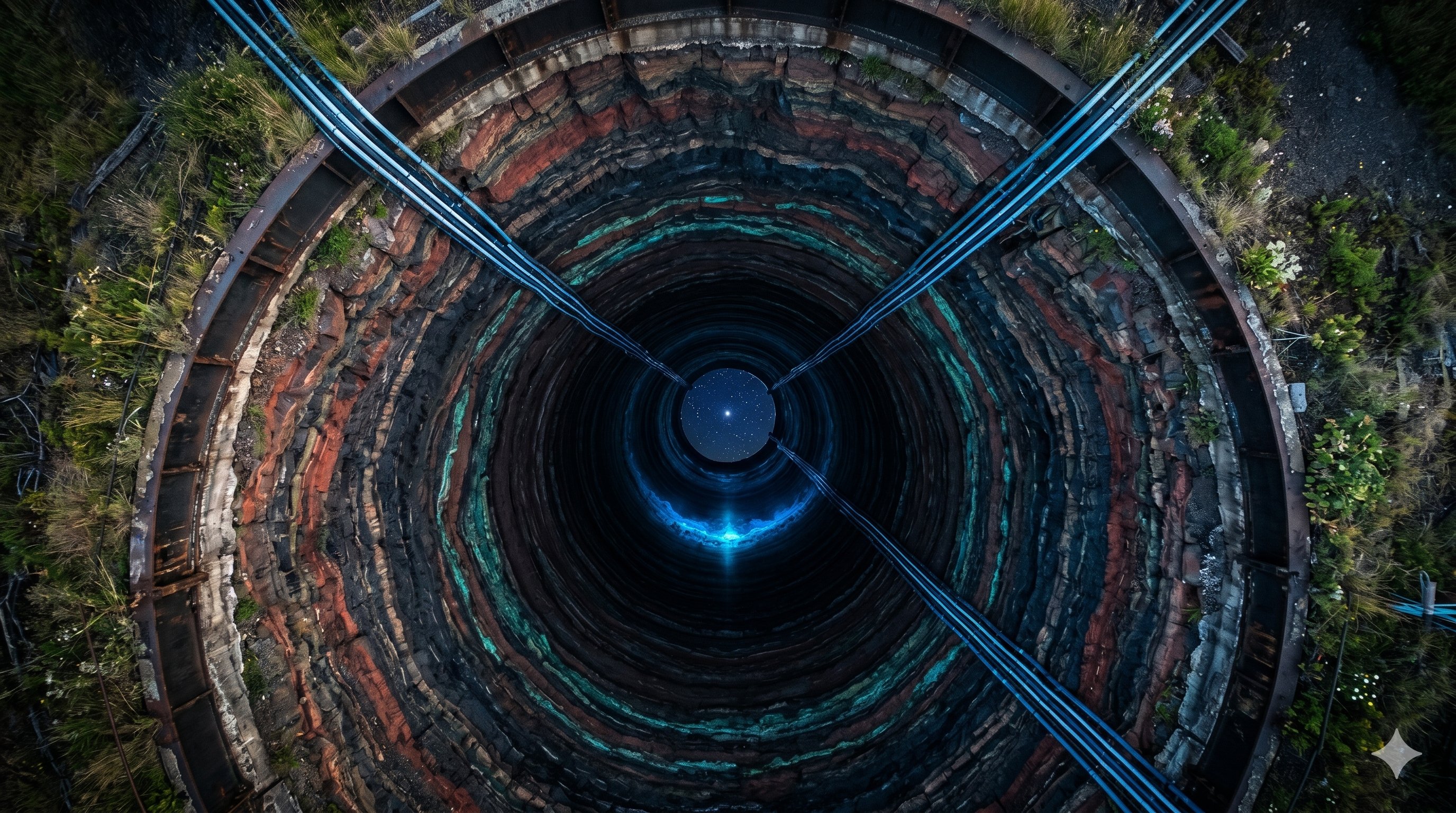
Underground Pumped Hydro Storage
We convert abandoned hard rock mines into firm, dispatchable underground power infrastructure for AI compute — delivered directly behind the meter.
950
Sites Screened
15
States
50yr
Asset Life
How It Works
Water stored in the upper reservoir falls through the shaft, drives a turbine at depth, and is pumped back overnight using curtailed renewable energy.
Energy stored as potential head. Power delivered firm, on demand, behind the meter. Renewable surplus is not a problem for LurraGrid. It is the recharge source.
The Market Reality
AI compute demand is doubling every 18 months. Grid interconnection queues run five to seven years.
Renewables produce surplus energy the grid cannot absorb — overnight, midday, off-peak. That surplus is our recharge fuel.
LurraGrid absorbs that surplus, stores it underground, and dispatches firm behind-the-meter power when AI compute needs it most.
The Architecture
Underground Storage & Dispatch
Existing hard rock shafts become upper and lower reservoirs. The mine is the battery.
Patent-Pending Continuity
Dual-reservoir threshold switching designed to support continuous dispatch across reservoir cycles.
Renewable Surplus Recharge
Acquires curtailed energy during off-peak windows. Renewable intermittency is our recharge strategy.
The Portfolio
LurraNode 001
Negaunee, Michigan · Hard Rock Iron Ore
Depth: 3,500 ft
Phase 1 — Anchor Site
LurraNode 002
Hancock, Michigan · Hard Rock Copper
Depth: 6,200 ft
Phase 2
LurraNode 003
Virginia City, Nevada · Silver & Gold
Depth: 3,360 ft
Phase 3
Peer-Reviewed Foundation
Michigan Technological University. Alfred P. Sloan Foundation Grant G-2018-11305. Prior art published Zenodo, May 2026.
Partner With LurraGrid
Data center operators, municipal mine owners, EPC partners, and institutional investors — every conversation starts here.