For Municipal Partners & Mine Owners
LurraGrid helps mining communities evaluate whether yesterday's industrial infrastructure can become tomorrow's power, thermal, and compute infrastructure — on terms that respect the community's history, ownership, and long-term interests.
LurraGrid does not see abandoned mine communities as forgotten places.
We see infrastructure communities with legacy assets that may have a second life.
The Story of a Mine Community
Then
The mine opens.
Community builds around it. Generations find work, purpose, and identity in the shaft and on the surface.
The economy grows.
Schools, businesses, families — all built on the foundation of what comes out of the ground.
The trades flourish.
Welders, pipefitters, engineers, operators — skilled blue-collar work at fair wages, passed between generations.
The Gap
The mine closes.
Not always with warning. Not always with a plan. The shaft goes quiet.
The question arrives.
What do we do with what's left? The shaft. The surface structures. The land. The maintenance cost.
The asset sits.
Dormant. Expensive to maintain. Too complex to redevelop conventionally. A question with no easy answer.
What LurraGrid Asks
What if the shaft has a new purpose?
The same depth that made the mine valuable for ore may make it valuable for energy storage and dispatch.
What if the trades come back?
Shaft rehabilitation, turbine installation, operations — the same skills, a new industrial purpose.
What if the community earns again?
Tax base, permanent jobs, thermal infrastructure, compute economy — built on the foundation already in the ground.
A Different Way of Seeing the Asset
How the mine is often seen
Environmental liability
Maintenance cost with no return
Dormant industrial land
Water management burden
Redevelopment obstacle
Community reminder of what was lost
How LurraGrid looks at the same asset
Hydraulic head potential
Thermal mass for energy and cooling
Industrial land already permitted
Working fluid in a closed system
Foundation for compute infrastructure
Community legacy with a second chapter
What a LurraNode Is Designed to Create
Long-Term Tax Base
A mine that may have been a cost center can potentially become part of a revenue-generating infrastructure asset.
Skilled Jobs — Blue & White Collar
Shaft engineers, turbine operators, control room technicians, project managers, environmental monitors. Construction and permanent roles.
LurraTherm Community Heat
Waste heat redirected toward district heating, greenhouses, municipal buildings. Site feasibility determines what is viable.
Compute Economy Anchor
Data centers near a LurraNode bring fiber, facilities, logistics, housing demand, and service economy growth.
Industrial Heritage Preserved
The headframes, the history, the identity of the site — honored and reactivated, not erased.
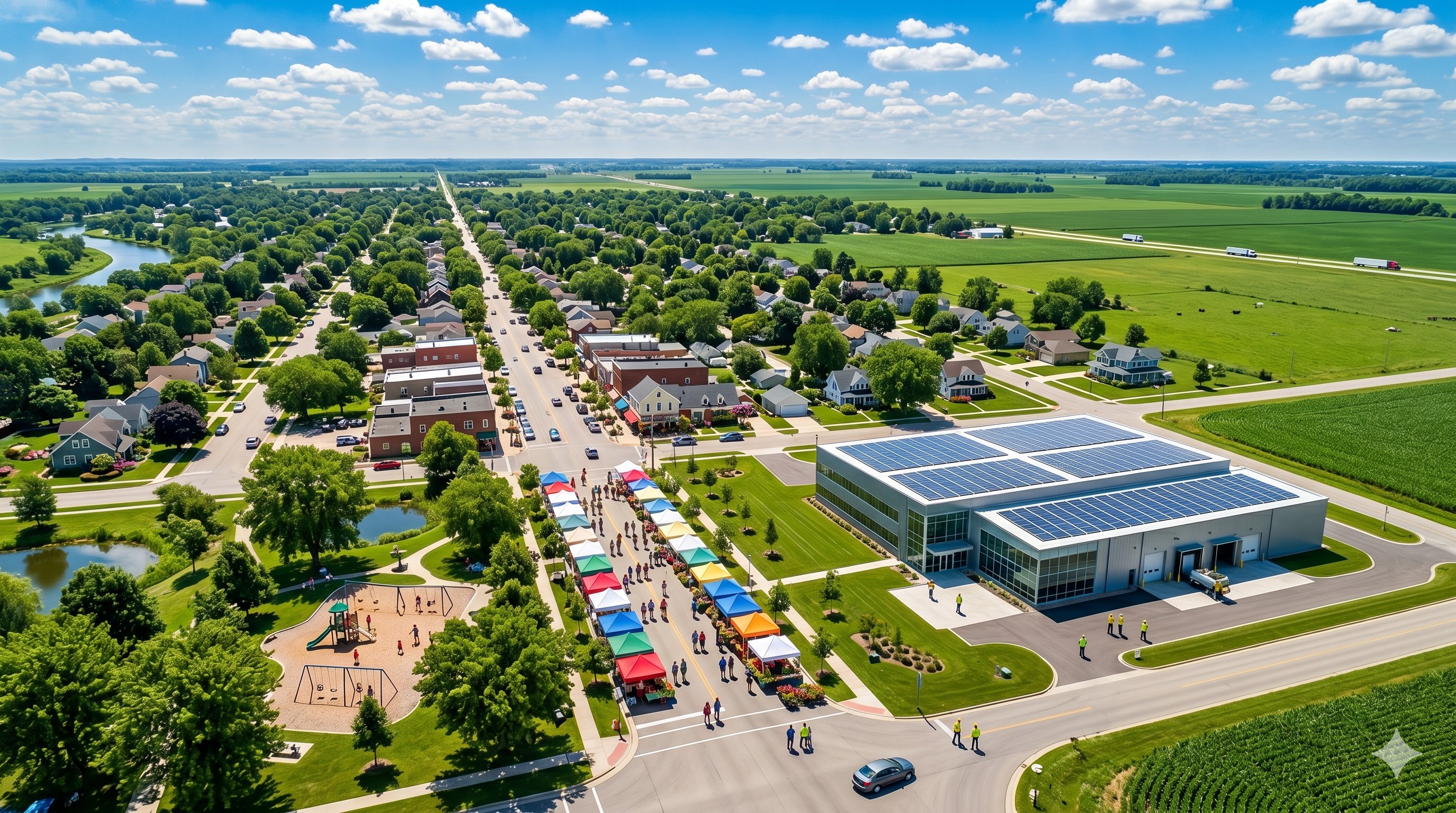
The infrastructure that built these communities
may be the infrastructure that powers their next chapter.
LurraTherm
Heat
As Community Asset
Data centers generate heat. Conventional facilities discharge it. LurraTherm is designed to evaluate whether that heat can be redirected toward beneficial community use. Site-specific feasibility determines what is viable where — we do not promise district heating for every community, but we commit to evaluating it seriously at every site.
District heating
Greenhouse agriculture
Aquaculture systems
Industrial process heat
Municipal buildings
Water treatment support
The Questions We Expect
Will it be noisy?
LurraCore operates underground. Turbines, pumps, and water flow are contained within the shaft and cavities. Surface operations are designed around the existing industrial footprint of the mine site.
Will it affect our water supply?
LurraGrid's objective is to design each LurraNode around a closed-cycle water system that minimizes dependence on municipal water supply. Site-specific hydrology, water chemistry, treatment requirements, and permitting determine the final operating plan.
What about the environment?
LurraCore is designed as a non-combustion dispatch system. The goal is to minimize new land disturbance by working within or around existing industrial footprints where feasible. Environmental review is part of every site development process.
Will you respect what the mine means to us?
The mine built the community. We are not here to rebrand it or erase it. The industrial archaeology of the site — the headframes, the surface structures, the documented history — is part of what makes a LurraNode meaningful. LurraGrid works with communities, not over them.
Will it create jobs for local people?
Site-specific construction and operations scope determines the answer. We do not make uniform job guarantees across sites. What we commit to is that every LurraNode development includes a community employment discussion as part of the project structure — from construction to permanent operations.
LurraAtlas
950
Potential Sites
Across 15 states
Not every mine is a LurraNode candidate. LurraAtlas — our proprietary site screening framework — is built around a screened universe of roughly 950 potential sites across 15 states. If your mine meets the basic profile, the conversation is worth having.
Strong hydraulic head potential, generally driven by shaft depth and usable elevation differential
Sufficient underground cavity volume for dual-reservoir storage at economic scale
Viable groundwater management pathway — not absence of water, but manageable water
Clear ownership structure — municipal, state, or federal mine owners are preferred partners
Proximity to transmission infrastructure or potential behind-the-meter compute load
Geological documentation from active mining operations
Not sure if your site qualifies? That is what the first conversation is for.
No commitment required at the first step. No purchase offer. No development agreement. Just an initial review to determine whether the site deserves a deeper technical and municipal conversation.
Start a Site Conversation →